Driving in France can be challenging, especially if you can’t read French. The thought of getting in the car and navigating roads at 60+ mph in a foreign country can be scary. But really, it’s pretty much the same as driving in the U.S.A. and most other countries. The exception being the UK, as they drive on the wrong side of the road 😉 French road signs are pretty straightforward and use a lot of universal symbols. However, it is important to know what those signs mean and how you should interpret them. This guide will help you travel safely and successfully in France.
On our recent road trip, I took pictures of signs we passed on both the interstate and local roads. A few times I had to have the kids translate a word or two for me. It’s so nice to travel with kids that are pretty much fluent in the language! But first, lets look at some key vocabulary.
French Vocab.
Travaux = works (ie. road work)
Attention = attention
Ouvert = open
Fermé = closed
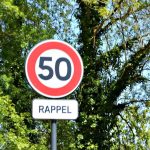
Rappel = reminder (you’ll see this under the speed limit signs as a reminder to the speed limit. It’s a reminder to you that you are still in that speed zone – not that it has changed)
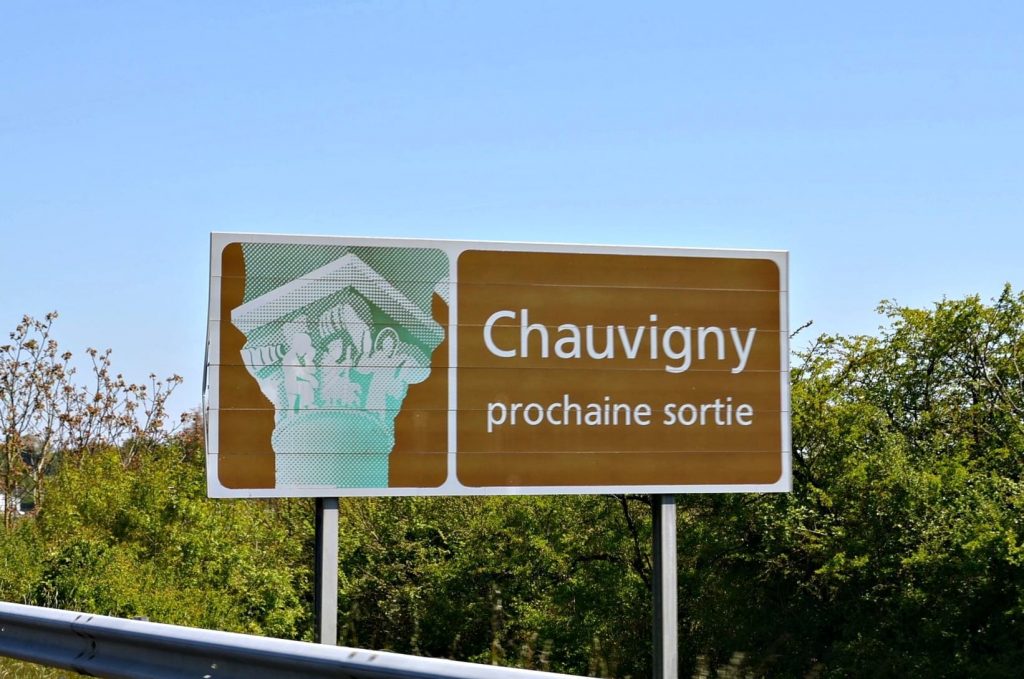
Prochaine sortie = next exit
Sortie = exit
Péage – toll road
Sauf = except
Cédez le passage = yield or give way
Toutes directions = all directions
Route barre = road closed
Sens unique = one-way
Suivre = follow
Arrêt = stop
Serrez à droite = keep to the right
Allumez vos feux = Turn on your lights
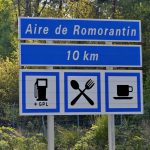
Aire de XX = rest stop of X town
Gendarmerie = police station
Rue = street
Guide to French Road Signs
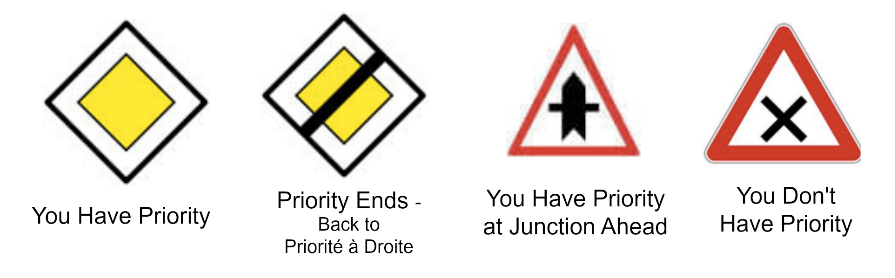
It is also important to note that in France there is priorité à droite or the right-of-way is to cars entering from the right. This is always the case unless you have a sign with a yellow triangle giving you priority. While you won’t really find people merging into your lane as if you weren’t there as they enter the highway, they do have the right of way. If there is an accident, you are at fault. This is opposite of in the U.S., where priority is given to those already on the highway.
No Driving in the Left Lane
Also, when driving on French highways (autoroute), drive on the right and pass on the left. DON’T drive on the left. Of course, in congested areas there will be cars in all lanes, but slower traffic always keeps right. We’re always amazed how pretty much everyone follows this rule. I wish my fellow Americans could follow this rule at home. The left lane is only for passing. Once past a vehicle, people move to the right lane. If there are three lanes, people will stay to the far right lane and use the middle lane for passing also. We’ve never seen anyone pass in the right lane. People tend to wait (very impatiently with flashing headlights) for the person in the left to move over. No zig-zagging here!
White Lines
As in other countries, you don’t cross solid white lines. This is particularly important to follow in France. Cross lanes only at dashed white lines. You might also see longer lines with dashes on the side of the road. These are to help show distance and serve as a reminder to how close you are following the vehicle ahead. Two cars shouldn’t be in the same line at the same time. If you’re in the same line, you’re following too close to the car in front in you.
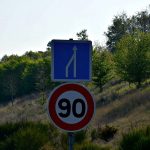
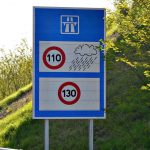
Speed limit
Please note – Speed is in km/h and distance in kilometers (km) or meters (m).
Depending on the area, you might also see speed limit signs with a car under it and another with a weight such as 3.5t. The cars may be able to go 110 km/h but the 3.5+ ton trucks can only do 90 km/h.
Make sure to watch your speed. There are speed cameras along the routes. If caught by a camera for speeding, you will get a ticket in the mail OR a bill from your rental car agency for their time sending your information to the authorities and a ticket in the mail. Save money – don’t speed! Ask me how I know…..
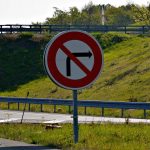
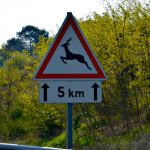
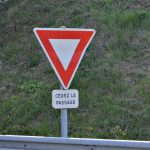
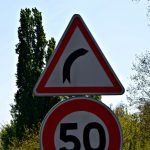
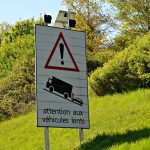
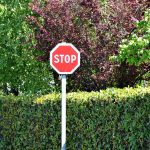
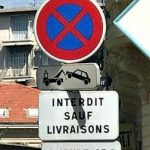
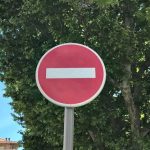

Warning!
Red on signs means danger!! You are being warned about something and need to be alert. It maybe a curve in the road, narrowing road, animals, no passing, pedestrians, etc. The signs are mostly self-explanatory, but you should pay close attention when seeing red signs.
The traditional yield sign above is common when entering roundabouts showing who yields. Yield to traffic already in the roundabout, but don’t stop if there is no one coming. Most cities in the US don’t have roundabouts and drivers can easily get confused. Those multi-lane roundabouts with stop lights can be a real doozy!
Pay special attention to the red sign with the white horizontal line. It means NO entry. This one is super important especially since France has a ton of one-lane roads. Additionally, the blue sign with a red “x” means that vehicles are prohibited.
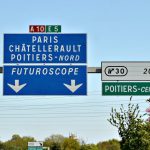
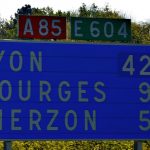
Direction
You’ll notice that the directional road signs are color coded in France. The signs are pretty standard but it’s important to know the exit number of the local road. In the image to the left, exit #30 is to the right in 200m. Typically you won’t see a sign below it indicating the area unless it’s a major city.
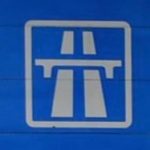
Blue background with white letters indicates Autoroute (the highway with tolls).
Green background with white letters indicates major European roads (crosses national borders).
Red background with white letters indicates major National roads (trunk roads – crossing broad areas of France and are now mostly maintained by local authorities instead of Nationally).
Yellow background with black letters indicates departmental & temporary roads such as detours.
White background with black letters indicates local roads.
What do I do?
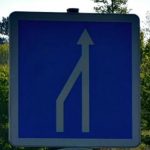
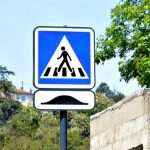
Signs with a white edge and a blue background tell you what you have to do. Above is a sign for merging traffic and a double sign with pedestrian crossing and speed bump.
Rest Areas
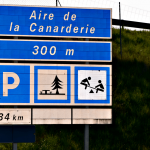
Autoroutes have a ton of rest stops, but they are not all created equal. If you need to stop and stretch your legs and use the restroom, you can pull into pretty much any area. I prefer to stop at the rest areas that also include a gas station and food, as the bathrooms are usually cleaner. The handy images will tell you exactly what can be found at each rest area and how far away it is. These rest areas are literally just off the autoroute, so pull in and get back on with ease.
By taking a few minutes to review the important vocabulary and French road signs, you should have no problem navigating the roads in France. Be vigilant when seeing a sign in red and always remember to drive in the right line.
Depending on where you’re traveling, we have several guides to visiting France. Including our popular 40 things to know before visit Paris.
Safe travels!
Can you please tell me what the black squares with the letter S and a number in yellow signify on junction exit signs on French autoroutes ? Many thanks
It is very useful, Thank you.
There is 1 road sign, probably of little significance that I’ve never fully understood!
A square with blue background and a white car symbol. And, if I remember correctly there is a similar sign with a bus !?
A square blue road sign with a white car is to indicate a limited-access road: no pedestrians, bicycles, horse riders… A square blue road sign with a white bus is to indicate a bus stop, cars are not allowed to stop there. A round blue sign with a white bus on it is to indicate a bus lane.
Thanks for helping to clarify these signs!
The traffic sign for a speed bump is “dos-d’âne”, not “pas d’âne”. Literally a donkey’s back.
Thank you so much for this useful post! I am traveling in France and plan to pick up a car to drive through Normandy and your site was extremely useful – I am feeling more confident and informed. The pictures were a great help! Thank you for taking the time to create this.
So glad it helped! Enjoy your trip!
French motorways are empty, large and mostly roadwork free, the least stressful drive I have EVER had! If you are foreign you can mostly get away with anything 😆. Beware however the French DONT stop at Zebra crossings for pedestrians, it’s one for all out there guys!
Don’t ever consider driving in the UK unless you travel in the middle of the night or avoid motorways 🤦♀️
Yes, driving the UK was a more difficult experience.
Very good guide, only thing I will say is blue background with red X is no stopping and the same but with / is no parking rather than no vehicles allowed. No vehicles is a red ring with white centre
THANK YOU
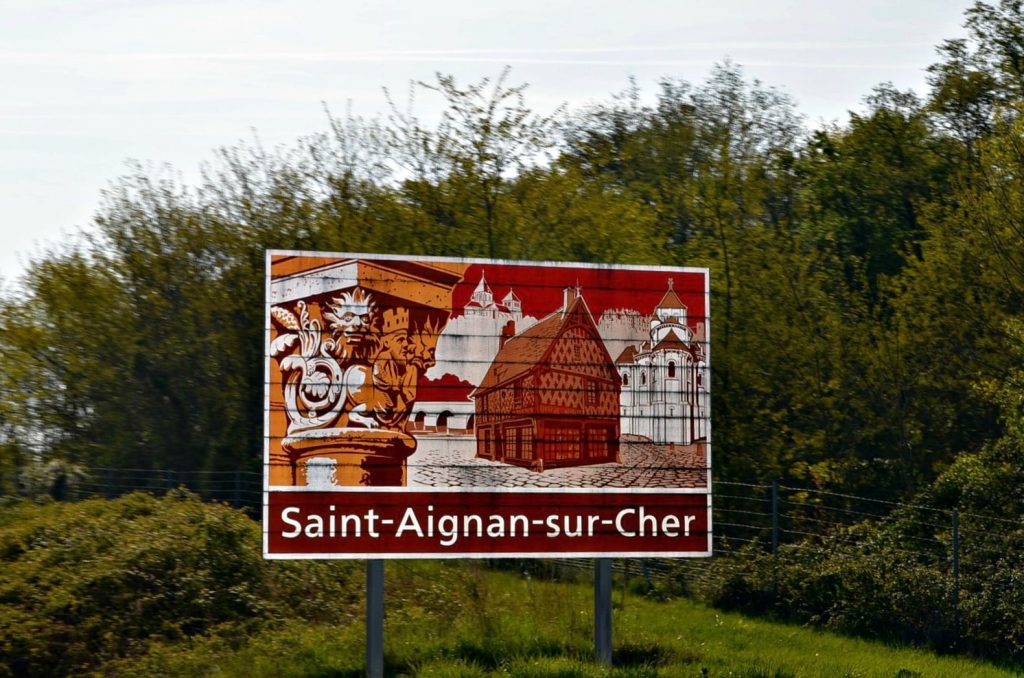
I’ve just returned from France. I made a visual journal of our trip and photographed quite a few of the pictorial road signs, to put in the journal, indicating our route. Signs like the ‘Saint-Aignan-sur-cher’ one at the top of your post.
Are these boards tourist-board in origin? are they indicating local landmarks? Any info would be greatly appreciated. I think they are lovely, some are really eye-catching!
These are tourist signs and you’ll notice that the background is the historical landmarks or sites and attractions in the city or village. I love how detailed some of the signs are. I believe they started in the 70’s in France. I hope you had a lovely trip!
We visited a few years ago and tried to capture the tourist signs of castles, etc but failed miserably (my husband is a fast driver). I thought I might be able to track them down once I got home but have not been able to find anything worthy of enlarging into a canvas for my living room. Would you be willing to share your photos?
What photo are you looking for?
Cheers my friend XX by
Dear Travelling ..This is very useful. I commiserate with the foreign driver…he has to remember all these while trying to maintain speed and care…the significance of the colors, lines numbers, warnngs etc. I have not driven much there but I have bern a passenger often and I tended not to mind them save when I am asked to help as “navigator”. Thanks to you I will no longer ignore them. Just some additional comments: a sign says “amende” — this translates as “fine”. Also, what I lke about French road signs (also l
applies to city transport buses) –when a town/city name has a RED diagonal line this means the end of the town/city limit and so one is leaving it. (on buses it means the bus is on a return trip). You can explain that better han me. PS not to be picky, but two typos in the vocab list:: spelling of OUVERT (open) ) and Allumez VOS feux
I can be stressful driving in a foreign country, especially the first couple of time. Derrick is the driver in my family and I’m the navigator. Great reminder about the red diagonal line through the signs.
Thanks for the spelling corrections! My English spell check does not like French words 🙂